
Common Elbow Injuries We Treat
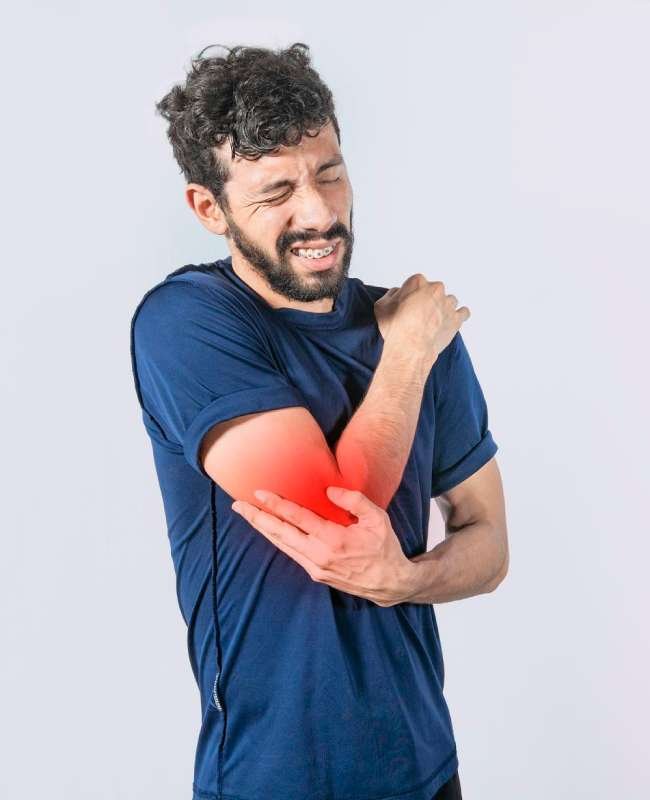
Tennis Elbow (Lateral Epicondylitis)
Many tennis players develop pain on the outer (lateral) aspect of the elbow. This is a form of tendinitis called lateral epicondylitis or “tennis elbow”. Lateral epicondylitis is an overuse injury of the tendons that extend (lift up) the wrist attach to the end of the arm bone in the elbow area. These wrist extensor muscles pull the wrist and fingers backward and contract strongly with any gripping activity of the hand. A small common extensor tendon at the outside of the elbow anchors a large group of extensor muscles in the forearm. Repetitive gripping and strong use of these extensor muscles can cause tissue failure at the muscle-tendon junction, causing the tendon to become inflamed. This produces the pain on the outside of the elbow.
Contributing Factors
• Weak muscles
• Overuse - playing or working with excessive and repetitive forceful gripping
• Gripping while extending or twisting of themwrist.
• Improper equipment - incorrect grip size, strings too tight
• Racquets / tools that are too heavy or unbalanced.
• Poor playing technique - too much wrist action, jerky strokes, poor ball contact.
Treatment
—Rest
You may have to temporarily stop the aggravating activity. A period of rest is most important to allow the injury a chance to heal. You will make the condition worse by continuing the activity that causes the injury, especially if you experience pain. Avoid heavy lifting or carrying, opening doors or handshaking repeatedly.
—Ice
Apply cold to your elbow three times a day for 20 to 30 minutes at a time in the early painful stage and for 20 minutes after active use of your arm. Protect your skin by putting a towel between your elbow and the ice bag.
—Stretching
Stretching will help prevent stiffness by making the muscles more flexible and by breaking down any scar tissue that may result from the inflammation.
—Physical Therapy
Exercises to strengthen the forearm muscles can begin as soon as the pain subsides. Building strength will help protect the injured tendon and prevent the injury from happening again.
—Medication
Sometimes anti-inflammatory medication helps reduce the pain. If you do not have a problem with this type of medication, you may take Aleve, one or two tablets twice a day with meals. Or, you may take Advil or aspirin. Cortisone will probably reduce the pain for a few months but may not change the length of time it takes the injury to heal. After receiving a cortisone injection, you should not play sports or use the arm forcefully for about two weeks.
—Brace
A counter-force brace which is an elastic strap that is worn one to two inches below the elbow. This type of brace gives compression to the forearm muscles and helps lessen the force that the muscle transmits to the tendon. At first, the brace may be worn at all times but as the pain subsides, the brace is necessary only for protection during activities that stress the injured arm.
—Surgery
Surgery is rarely required but is sometimes useful to correct chronic or recurrent tendinitis.
Returning to Sports
—Warm up
Always warm up before you play. Put all of your major joints through their complete range of motion and work up a “sweat” prior to stepping on the tennis court or golf course. Follow this by slowly performing the motions that you use in your sport. In tennis, do easy
strokes next, and then slowly increase your intensity until you are sweating again. The forearm muscles should be stretched well after the warm up.
—Your Racquet/Club
Use a lighter weight racquet and move your hand up a bit on the grip. Change to a racquet that has greater spring. Reduce the string tension. Grip size can also be an important factor. If possible, discuss equipment with your local pro.
—Your Stroke
In tennis, the forehand stroke, the serve or the overhead can cause medial epicondylitis especially if a lot of spin is applied. Avoid the shots that aggravate the problem. Reduce wrist motion to a minimum. Lessons may be necessary to alter your strokes.
—Your Game
When you return to your sport, start back slowly. In tennis, warm up first and rally at first for only short periods of time, avoiding problem shots. Play less time each day or play doubles. Avoid playing competitive games until your elbow is healed. In golf start with only putting and chip shots. Slowly work up from a few holes to a complete game.
—After the Game
Stretch the muscle after you are through playing. Apply ice to the elbow for 20 minutes.
Exercises
Exercises to stretch and strengthen the muscles attached to the injured tendon will help with the healing process. Stretches and exercises should be avoided if they are painful. The following exercises can be done every other day until your symptoms subside. Continue to use the exercises as a warm-up before tennis, golf or other gripping activities.
Resisted Wrist Flexion
With a light weight in the affected hand keep the palm facing up and bend the wrist and hand upward as far as you can. Hold one count and lower slowly 3 counts. Repeat 10 to 20 times, two times per day.
Resisted Wrist Extension
With a light weight in the affected hand keep the palm facing down and bend the wrist and hand upward as far as you can. Hold 1 count and lower slowly 3 counts. Repeat 10 to 20 times, two times per day.
Resisted Forearm Supination and Pronation
Holding a dumbbell, with the forearm supported on your thigh, slowly turn the palm facing up and then slowly turn the palm facing down. Make sure to hold the elbow still and only move the forearm. Repeat 10 to 20 times each way, one to two times per day.
Wrist Flexor Stretch
Hold the arm with the elbow straight and the palm facing up. Grasp the involved hand at the fingers and stretch the wrist backward, until a stretch is felt on the inside of the forearm. Hold 15 seconds, repeat 3 to 5 times, 2 to 3 times per day.
Wrist Extensor Stretch
Hold the arm with the elbow straight and the palm facing down. Push downward on the back of the involved hand until a stretch is felt in the muscles on the outside of the forearm. Hold 15 seconds, repeat 3 to 5 times, 2 to 3 times per day.
Ulnar Collateral Ligament
What is the ulnar collateral ligament?
A ligament is a structure that holds bones together and helps to control the movement of joints. A good way of thinking about it is that a ligament is a tether between the bones. When the ligament is torn, the tether is too long and the bones move too much. This can lead to pain, a sense of instability or looseness, and inability to work or perform your sport.
The ulnar collateral ligament (UCL) complex is located on the inside (or medial side) of the elbow (small finger side of the arm), and is attached on one side to the humerus (the bone of the upper arm) and on the other to the coronoid process of the ulna (a bone in the forearm). It is composed of three bands or divisions — the anterior, posterior and transverse bands — with the anterior band providing the arm’s primary restraint from stress to the elbow. The largest stresses in the elbow are those forces that cause twisting and bending of the elbow, such as the throwing of a baseball or javelin. These motions put extreme stress on the ligament during certain parts of the motion.
How is the UCL injured?
The UCL can be injured in several different ways. Most commonly, there is a gradual onset of medial elbow pain due to repetitive stresses on the ligament. For athletes participating in overhead or throwing sports, poor mechanics, inflexibility or fatigue can eventually lead to muscle strain, which places more stresses on the UCL. These stresses create microscopic tears in the ligament, which can add up to one large tear over time. This gradual stress causes the ligament to stretch and become too long. Once it gets too long, it no longer holds the bones tightly enough during throwing activities .
What are the symptoms of a UCL injury?
- A sharp “pop” or pain along the inside of the elbow joint on one particular throw, leading to the inability to continue throwing
- Pain on the inside of the elbow after a period of heavy throwing or other overhead activity
- Pain during the phase of throwing when the arm accelerates forward, just prior to releasing the ball
- Tingling or numbness in the last two fingers (pinkyand ring fingers) of the hand
While the instability resulting from a tear of the UCL may inhibit the ability to participate in throwing sports, it is unlikely to impair the activities of daily living, such as carrying a bag of groceries. Interestingly, a tear of the UCL rarely prevents exercising, lifting weights, batting, running or other nonthrowing sports.
How is a tear of the UCL diagnosed?
A tear of the UCL can often be diagnosed by a physician through a history and physical examination. A valgus stress test, where a physician tests a patient’s elbow for instability, is the best way for a physician to assess the condition of the UCL. An MRI scan and X-ray may also be done to further assess the condition of the structures in the patient’s elbow, but these tests are not the sole basis for a diagnosis. These tests often demonstrate changes in the ligament, indicating it has been under stress, which is common in athletes that throw in their sport. Sometimes it will show a definite tear in the ligament, but oftentimes an MRI alone will not provide a conclusive diagnosis. Injecting dye (gadolinium) into the joint before the MRI sometimes increases its accuracy. The most difficult part of treating a UCL problem is making the diagnosis. This is because the examination is often inexact, and the tests are not 100 percent accurate.
UCL Tear Treatment
The treatment options following a UCL tear depend primarily on the patient’s goals. If joint stability and pain relief are the patient’s main goals, then nonsurgical treatment is usually adequate. But if the patient wishes to return to strenuous overhead or throwing activities and
they do not respond to nonoperative treatments, then surgical treatment of the torn UCL is recommended.
—Nonoperative Treatment
The goal of nonoperative treatment of a torn UCL is to restore stability to the elbow joint and provide pain relief to the patient. Treatment consists of an initial period of rest along with taking nonsteroidal anti-inflammatory medications — like aspirin, ibuprofen, naproxen, etc. — and applying ice to the elbow daily until the pain and swelling are gone. After inflammation of the elbow has decreased, the patient may begin physical therapy. The purpose of the physical therapy is to strengthen the muscles around the elbow to compensate for the torn ligament.
—Surgical Treatment
There are two types of surgical treatments used in dealing with a torn UCL:
• Repair of the existing ligament, which is only performed when the ligament has pulled away from its humeral attachment; this is known as an “avulsion” and is rare.
• Replacement (reconstruction) of the ligament, which is when the ligament is reconstructed using a tendon taken from somewhere else in the body — typically, the graft material is a tendon from the patient’s own body (an autograft), but occasionally the
ligament is reconstructed with a donor tendon (an allograft).
The most common tendon used for replacement is the palmaris longis tendon in the wrist and forearm, but some people are born without this tendon. Other tendons that can be used include forearm tendons, toe tendons, a hamstring tendon or part of the Achilles tendon. There are advantages and disadvantages to each.
The surgery is usually performed after a nerve block of the arm so that it is completely numb. A 10-centimeter incision is made on the inside of the patient’s elbow. To expose the anterior band of the UCL, the flexor-pronator muscle in the forearm is split lengthwise. This muscle-splitting approach is less traumatic to the muscle than detaching the muscle from the bone and may allow the patient to recover faster and with less pain. However, sometimes it is necessary to release the muscles to get more exposure; the muscles are reattached and the recovery is still excellent with no known bad effects.
Tunnels are then drilled in the ulna and humerus at the site of attachment of the original anterior band of the UCL. The graft is then passed through these tunnels to form a figure-of-eight. Any remnants of the patient’s original ligament are sutured into the graft to give it added strength.
What are the results of surgery?
Approximately 75 to 85 percent of athletes return to their previous level of competition following reconstruction of the UCL. Some baseball pitchers even report increased velocity after surgery. The average rehabilitation time for throwing athletes is about one year, but it may take up to 24 months for a patient to return to his or her previous ability level.
What are the potential problems of surgery?
The most common complications following surgery involve the nerves in the elbow, but fortunately these are uncommon with modern techniques. Ulnar nerve symptoms are the most common problem, and they are usually just tingling and numbness, which goes away shortly after surgery. Nerve impairments usually can be corrected by reoperation if necessary. Stretching or even a rupture of the graft is possible but very uncommon. In these cases, a new graft may be used to perform a second reconstruction.
POST-OPERATIVE REHABILITATION PROTOCOL FOLLOWING ULNAR COLLATERAL LIGAMENT RECONSTRUCTION USING AUTOGENOUS
PALMARIS LONGUS GRAFT
I. IMMEDIATE POST-OPERATIVE PHASE (0-3 weeks)
Goals:
1. Protect healing tissue
2. Decrease pain/inflammation
3. Retard muscular atrophy
4. Protect graft site – allow healing
A. Post-Operative Week 1
Brace: Posterior splint at 90 degrees elbow flexion
Range of Motion: Wrist AROM ext/flexion immediately postoperative
Elbow postoperative compression dressing (5-7 days)
Wrist (graft site) compression dressing 7-10 days as needed
Exercises: Gripping exercises Wrist ROM
—Shoulder isometrics (No Shoulder ER)
—Biceps isometrics
—Cryotherapy: To elbow joint and to graft site at wrist
B. Post-Operative Week 2
Brace: Elbow
ROM 25-100 degrees (Gradually increase ROM – 5 degrees Ext/10 degrees of Flex per week)
Exercises: Continue all exercises listed above
—Elbow Range of Motion in brace (30-105 degrees)
—Initiate elbow extension isometrics
—Continue wrist ROM exercises
—Initiate light scar mobilization over distal incision (graft)
—Cryotherapy: Continue ice to elbow and graft site
C. Post-Operative Week 3
Brace: Elbow ROM 15-115 degrees
Exercises:
Continue all exercises listed above
—Elbow ROM in brace
—Initiate active ROM Wrist and Elbow (No resistance) Initiate light wrist flexion stretching
—Initiate active ROM shoulder;
-Full can
-Lateral raises -ER/IR tubing
-Elbow flex/extension
—Initiate light scapular strengthening exercises
—May incorporate bicycle for lower extremity strength & endurance
II. INTERMEDIATE PHASE (Week 4-7)
Goals:
1. Gradual increase to full ROM
2. Promote healing of repaired tissue
3. Regain and improve muscular strength
4. Restore full function of graft site
A. Week 4
Brace: Elbow ROM 0-125 degrees
Exercises:
—Begin light resistance exercises for arm (1 lb)
—Wrist curls, extension, pronation, supination
—Elbow extension/flexion
—Progress shoulder program emphasize rotator cuff and scapular stabilization
—Initiate shoulder strengthening with light dumbbells
B. Week 5
ROM: Elbow ROM 0-135 degrees Discontinue brace
Continue all Exercises: Progress all shoulder and UE exercises (progress weight 1 lb.)
C. Week 6
AROM: 0-145 degrees without brace or full ROM
Exercises:
—Initiate Thrower’s Ten Program
—Progress elbow strengthening exercises
—Initiate shoulder external rotation strengthening
—Progress shoulder program
D. Week 7
—Progress Thrower’s Ten Program (progress weights)
—Initiate PNF diagonal patterns (light)
III. ADVANCED STRENGTHENING PHASE (Week 8-14)
Goals:
1. Increase strength, power, endurance
2. Maintain full elbow ROM
3. Gradually initiate sporting activities
A. Week 8
Exercises:
—Initiate eccentric elbow flexion/extension
—Continue isotonic program: forearm & wrist
—Continue shoulder program – Thrower’s Ten Program
—Manual resistance diagonal patterns
—Initiate plyometric exercise program
(2 hand plyos close to body only)
-Chest pass
-Side throw close to body
—Continue stretching calf and hamstrings
B. Week 10
Exercises:
—Continue all exercises listed above
—Program plyometrics to 2 hand drills away from body
-Side to side throws
-Soccer throws
-Side throws
C. Week 12-14
—Continue all exercises
—Initiate isotonic machines strengthening exercises (if desired)
-Bench press (seated)
-Lat pull down
—Initiate golf, swimming
—Initiate interval hitting program
IV. RETURN TO ACTIVITY PHASE (Week 14-32)
Goals:
1. Continue to increase strength, power, and endurance of upper extremity musculature
2. Gradual return to sport activities
A. Week 14
Exercises:
—Continue strengthening program
—Emphasis on elbow and wrist strengthening and flexibility exercises
—Maintain full elbow ROM
—Initiate one hand plyometric throwing (stationary throws)
—Initiate one hand wall dribble
—Initiate one hand baseball throws into wall
B. Week 16
Exercises:
—Initiate interval throwing program (Phase I) [long toss program]
—Continue Thrower’s Ten Program and plyos
—Continue to stretch before and after throwing
C. Week 22-24
Exercises:
—Progress to Phase II throwing (once successfully completed Phase I)
D. Week 30-32
Exercises:
—Gradually progress to competitive throwing/sports
Golfer’s Elbow (Medial Epicondylitis)
Medial Epicondylitis (Golfer’s Elbow)
Many racquet players and golfers develop pain on the inner side of the elbow. This condition is a type of tendinitis called medial epicondylitis or “golfer’s elbow”. Medial epicondylitis is caused by repetitive strong gripping while swinging a golf club or racket,
or by using the wrist too much during these motions. The condition is an overuse injury of the wrist flexor tendons that attach to the lower end of the arm bone (humerus) in the elbow area.
The flexor muscles of the forearm that bend the wrist toward the palm originate at the medial epicondyle of the humerus. Strong use of these muscles can cause injury at the point of maximum stress where the tendons attach to the bone on the inner side of the forearm.
Contributing Factors
- Weak muscles
- Overuse – repetitive forceful gripping while flexing and twisting the wrist
- Improper equipment – incorrect grip size, tight strings, or tools/racquets that are too heavy
- Poor playing technique – excessive wrist action, jerky strokes, or poor ball contact
Treatment
Rest
You may need to temporarily stop the activity causing the pain. Rest is important to allow the injury time to heal. Continuing the activity, especially when pain is present, can worsen the condition.
Avoid heavy lifting, carrying objects, repeatedly opening doors, or frequent handshaking.
Ice
Apply ice to your elbow three times per day for 20–30 minutes during the painful stage, and for about 20 minutes after activity. Place a towel between your skin and the ice pack to protect the skin.
Stretching
Stretching helps prevent stiffness by improving flexibility and breaking down scar tissue that may develop from inflammation.
Physical Therapy
Exercises to strengthen the forearm muscles can begin once the pain subsides. Strengthening helps protect the injured tendon and prevent future injuries.
Medication
Anti-inflammatory medications may help reduce pain. If appropriate for you, medications such as Aleve (one or two tablets twice daily with meals), Advil, or aspirin may be used.
Cortisone injections may reduce pain temporarily but may not shorten the healing time. After receiving a cortisone injection, avoid sports or heavy arm use for about two weeks.
Brace
A counter-force brace is an elastic strap worn one to two inches below the elbow. It compresses the forearm muscles and helps reduce stress placed on the tendon.
Initially the brace may be worn most of the time. As symptoms improve, it may only be needed during activities that stress the arm.
Surgery
Surgery is rarely required but may be considered for chronic or recurring tendinitis that does not improve with other treatments.
Returning to Sports
Warm Up
Always warm up before sports. Move all major joints through their full range of motion and build up a light sweat before playing tennis or golf.
Start with easy movements and gradually increase intensity. Stretch the forearm muscles after warming up.
Your Racquet or Club
Use a lighter racquet and consider adjusting your grip slightly higher. Choose equipment with more flexibility and reduce string tension if needed.
Grip size is also important. Consult a professional if possible when selecting equipment.
Your Stroke
In tennis, forehand strokes, serves, and overhead shots may contribute to medial epicondylitis, especially when excessive spin is applied.
Avoid painful strokes, limit wrist motion, and consider taking lessons to improve your technique.
Your Game
Return to sports gradually. Begin with light practice and short sessions. Avoid shots that cause discomfort.
In tennis, consider shorter play sessions or playing doubles. Avoid competitive matches until your elbow has healed.
In golf, start with putting and chipping before gradually returning to full rounds.
After the Game
Stretch the forearm muscles after activity and apply ice to the elbow for about
20 minutes.
Exercises
Exercises that stretch and strengthen the muscles attached to the injured tendon can support recovery. Avoid exercises if they cause pain.
These exercises can be performed every other day until symptoms improve and may continue as part of a warm-up routine before sports.
Resisted Wrist Flexion
Hold a light weight with your palm facing up. Bend the wrist upward as far as possible, hold briefly, then lower slowly over three counts.
Repeat 10–20 times, twice daily.
Resisted Wrist Extension
Hold a light weight with your palm facing down. Bend the wrist upward as far as possible, hold briefly, then lower slowly over three counts.
Repeat 10–20 times, twice daily.
Resisted Forearm Supination and Pronation
Hold a dumbbell with your forearm supported on your thigh. Slowly rotate your palm upward, then downward while keeping the elbow still.
Repeat 10–20 times each direction, one to two times daily.
Wrist Flexor Stretch
Extend your arm with the palm facing upward. Use the other hand to gently pull the fingers back until a stretch is felt along the inside of the forearm.
Hold for 15 seconds. Repeat 3–5 times, 2–3 times daily.
Wrist Extensor Stretch
Extend your arm with the palm facing downward. Use the other hand to push the hand downward until a stretch is felt along the outside of the forearm.
Hold for 15 seconds. Repeat 3–5 times, 2–3 times daily.
Distal Biceps Repair
Anatomy -
The biceps muscle goes from the shoulder to the elbow on the front of the upper arm. Tendons attach muscles to bone. Two separate tendons conncet the upper part of the biceps muscle to the shoulder. One tendon connects the lower end of the biceps to the elbow. The lower biceps tendon is called the distal biceps tendon. The word distal means further down the arm.
The distal biceps attatches to a small bump on the radius bone called the radial tuberosity. The radius is the smaller of the two bones between the elbow and the wrist that make up the
forearm.
Contracting the biceps muscle can bend the elbow upward. The biceps can help flex the shoudler, raising the arm up over heard. The biceps rotates, or twists, the forearm in a way that points the palm of the hand up. This motion is called supination and the biceps is a powerful supinator.
Why did I tear my biceps?
The most common cause is forceful contraction when lifting with the elbow bent.
Symptoms
What does a distal biceps rupture feel like?
An early diagnosis is best. If surgery is needed, people who’ve ruptured their distal biceps tendon usually have a better result when surgery is done soon after the injury.
How to diagnose Distal biceps ruptures?
Your surgeon will first understand your medical history, how the biceps will afftect your life and work. The physical exam is helpful in diagnosis a rupture. The hook test is very sensitive and specific to distal biceps injuries. X-rays and MRI may be ordered to undertsand certain
pathologies.
Non Surgical Treatment
Many doctors prefer to treat distal biceps tendon ruptures with surgery. Nonsurgical treatments are usually only used for people who do minimal activities and require minimal arm strength. Nonsurgical treatments are only used if arm weakness, fatigue, and mild deformity aren’t an issue. If you are an older individual who can tolerate loss of strength, or if the injury occurs in your nondominanat arm, you and your surgeon may decide that surgery is not necessary.
Not having surgery often results in significant loss of strength. Flexion of the elbow is somewhat affected, but supination (which is the motion of twisting the forearm, such as when you use a screwdriver) can be very affected. A distal biceps rupture that is not repaired reduces supination strength by about 50 percent.
Nonsurgical measures may include a sling to rest the elbow. Patients may be given anti- inflammatory medicine to help ease pain and swelling and get them back to activities sooner. These medications include common over-the-counter drugs such as ibuprofen. Your surgeon may have you work with a physical or
occupational therapist. At first, your therapist will give you tips how to rest your elbow and how to do your activities without putting extra strain on the joint. Your therapist may apply ice and electrical stimulation to ease pain. Exercises are used to gradually strengthen other muscles that can help do the work of
a normal biceps muscle.
Surgical Management
People who need normal arm strength get best results with surgery to reconnect the tendon right away. More urgent surgery is needed to avoid tendon retraction. When the tendon has been completely ruptured, contraction of the biceps muscle pulls the tendon further up the arm. When the tendon recoils from its original attachment and remains there for a very long time, the surgery becomes harder, and the results of surgery are not as good.
Rehab Protocol
The intent of this protocol is to provide the clinician with a guideline of the post- operative rehabilitation course for a patient that has undergone a distal biceps tendon repair. It is by no means intended to be a substitute for one’s clinical decision making regarding the progression of a patient’s post-operative course based on their physical exam/findings, individual progress, and/or the presence of post-operative complications. If a clinician requires assistance in the progression of a post-operative patient they should consult with the referring Surgeon.
Rehab Phases
- PHASE I: IMMEDIATE POST-OP (Day 0-1 WEEK AFTER SURGERY)
- PHASE II: INTERMEDIATE POST-OP (2-6 WEEKS AFTER SURGERY)
- PHASE III: LATE POST-OP (7-10 WEEKS AFTER SURGERY)
- PHASE IV: TRANSITIONAL (11-15 WEEKS AFTER SURGERY)
- PHASE V: RETURN TO SPORT/WORK (4-6 MONTHS AFTER SURGERY)
Phase 1: Weeks 1-2
Goals:
- Reduce post-op pain
- Reduce Swelling (edema)
- Protect the repair
- Optimize healing environment
- Regain Elbow motion
Precautions
Non-Weight bearing to the upper extremity
Intervention
Ice can improve the pain and is a powerful anti-inflammatory. Utilize Ice and or
an Ice machine to help with the pain and swelling.
Start early range of motion with flexion and extension and pronation and
supination of the forearm to tolerance.
Phase 2: Weeks 2-6
Goals:
- Regain full motion and start grip strengthening
- Protect the repair
Precautions
No Lifting more than 3 lbs
Intervention
Passive elbow extension exercises may be started if needed.
Light strengthening exercises are started with light tubing or 2-3lb weights for
elbow flexion, extension, forearm rotation and wrist flexion and extension.
Shoulder Theraband and strengthening exercises are started. Supine scapula
stabilization with 2-3 lb weight.
Ice after strengthening exercises.
Phase 3: Weeks 6-12 weeks
Goals:
- Regain full motion strength
- Protect the repair
Precautions
progress lifting and pushing/pulling
Intervention
The strengthening program is gradually increased so that the patient is
using full weights by 3 months. as long as 6 months before a patient returns
to heavy work.
Testing use grip strenth and Elbow ROM
Start ball toss an job specific duties.
Clinical Follow-up at 3 months
Schedule Your Consultation With Our Specialists
Schedule your next appointment quickly and conveniently with our team.